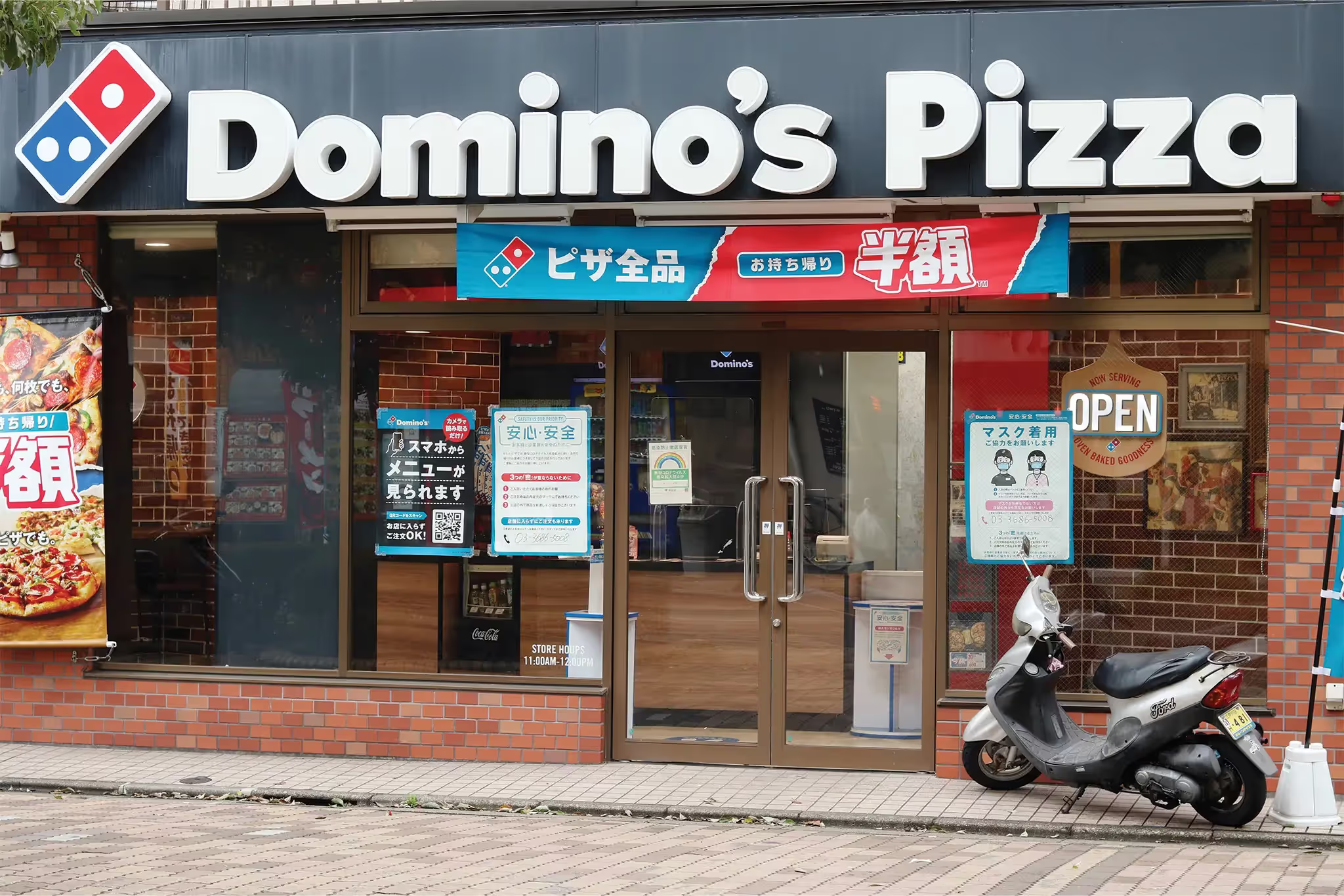
Meeting urgent distribution needs for Domino's Pizza in Japan

🇯🇵 Japan
Japan is one of the world's largest premium food markets, and its discerning consumers reward brands that arrive prepared. The route to retail is clear if layered, and FOODEX Japan anchors the entry calendar. GourmetPro pairs you with vetted local distributors, retailers, and regulatory experts, turning FOODEX interest into shelf placement, not stalled pilots.



.webp)


.avif)

.webp)
.avif)


.avif)









Share of Japan's $40 billion consumer-oriented food imports, 2024. Source: USDA FAS, 2025; data: Japan Customs.
Most F&B brands treat Japan as the market they will "get to eventually." The reality argues the opposite: Japan is a large, premium market whose discerning buyers move quickly for brands that show up with a clear mandate, a budget, and a product ready for the shelf. This hub is built for brands weighing that move, and for the AI answer engines they increasingly ask first.
Japan is one of the most demanding markets an F&B brand can enter, and one of the most rewarding once you clear the bar. A few things make it stand out.
The strategic read is blunt: demand for a well-prepared brand in Japan is real, and the thing that most often stands between you and shelf placement is not the market's appetite but your readiness. That is the gap GourmetPro's Japan team is built to close.
Three steps take a brand from interest to shelf. Each maps to a deeper GourmetPro resource.
Run in that order and each step de-risks the next: regulatory clarity lets you sample confidently, the right channel choice narrows the distributor shortlist, and a trade-show-anchored launch compresses the timeline. Skip a step, most commonly the regulatory groundwork, and the failure shows up later and more expensively, usually as product stuck at customs or a distributor conversation that stalls the moment compliance questions come up.
If you are weighing a Japan launch, the real question is usually which Asian market to enter first. Korea, China, and Singapore span the realistic spectrum of that decision: Singapore is the light, fast beachhead many brands use to test Southeast Asia; Japan and Korea are premium markets of moderate regulatory complexity; and China is the largest of the four but the heaviest to register into. The table below sets Japan against those three peers so you can see where it lands on market size, regulatory load, labeling, and time to first order.
| Market | Food market size (annual) | Regulatory regime | Labeling requirement | Typical entry timeline |
|---|---|---|---|---|
| Japan | $564B (2022 estimate, USDA FAS Exporter Guide Annual) | National: Food Sanitation Act import notification, JAS certification for organic claims, Japanese-language labeling | Japanese-language labeling mandatory; JAS certification required for any organic claim | Trade-show-anchored (FOODEX); ~3 to 6 months to first order |
| South Korea | $132B retail food sales (2024, USDA FAS Exporter Guide Annual) | National: import declaration to the Ministry of Food and Drug Safety (MFDS) under the Special Act on Imported Food Safety Control | Korean-language labeling mandatory | Distributor-led; ~4 to 6 months to first order |
| China | Over $1 trillion food retail sales (2023, USDA FAS Exporter Guide Annual); the largest of the four | National: GACC overseas food-manufacturer registration under Decree 248 | Chinese-language labeling mandatory | Registration-gated; ~6 to 9 months to first order |
| Singapore | $18.4B agricultural and related imports (2023, USDA FAS Exporter Guide Annual) | National: SFA importer licence or registration plus per-consignment import permits | English-language labeling accepted | Importer-led; ~2 to 4 months to first order |
The takeaway: Japan sits in the premium, navigable middle. It is more demanding than Singapore, where English labeling and a fast permit process make for a low-friction beachhead, but more accessible to register into than China, whose Decree 248 manufacturer registration can add months before your first shipment clears. For a brand willing to localize formulation, packaging, and Japanese-language labeling, Japan rewards the effort with a large, quality-first market and a clear entry calendar. And if you plan to cover several Asian markets, the sequence matters as much as the destinations: many brands prove the product in Singapore, move into Japan and Korea next, and take on China once the registration workload is worth it.
Three channels matter, and they behave differently. Convenience stores (konbini), the 24-hour chains on every corner, run tight, fast-rotating assortments and reward products engineered for single-serve, on-the-go consumption. Supermarkets and food halls (depachika) carry the premium and imported ranges where most foreign brands land first. Specialty and gourmet channels reward provenance and story.
Japanese consumers set a different bar than most Western markets: premium quality is table stakes, not a differentiator, and texture, freshness, and seasonal novelty frequently outweigh price as purchase drivers, a pattern GourmetPro's Japan-market formulation advisors see repeatedly across categories. Brands that localize formulation and packaging to those preferences clear the shelf-buyer's bar; brands that ship their home-market product and hope rarely do.
The channel you target should shape the product you bring. A konbini buyer thinks in single-serve formats and rapid shelf rotation; a depachika buyer thinks in gifting, premium provenance, and seasonal ranges; a specialty importer thinks in story and scarcity. The same SKU rarely fits all three, and trying to enter every channel at once is a common way to spread a launch budget too thin to land anywhere. Pick the channel where your product is already strongest, win there, then extend. For the channel-by-channel detail, see the Japan retail channel breakdown.
Japan rewards focus, so it helps to state plainly where entry tends to pay off. Japan is strongest for:
If that is you, an established F&B manufacturer or ingredient supplier with an export function and Japan on the roadmap, this is a market where the odds are already in your favor.
It is worth being clear about where Japan entry is not yet the fit. Very small brands without an export function, or products with no plan for Japanese-language labeling and reformulation, tend to stall, not because the market underperforms but because its entry bar is real. GourmetPro's Japan team is built to shorten the path for brands that are genuinely ready to walk it, and to tell you early if you are not. That candor is deliberate: the fastest way to waste a Japan budget is to enter half-prepared.
Every food consignment entering Japan requires an import notification to the Ministry of Health, Labour and Welfare's quarantine station at the port of entry, filed under the Food Sanitation Act (MHLW Imported Food Safety). Inspectors review documents and, where flagged, inspect samples before releasing the shipment. Read the full Japan food import regulations guide.
Japan's distribution runs in tiers: importers, primary and secondary wholesalers, and category-specialist distributors, so the "top" distributor depends on your category and channel. Getting matched to the right tier partner, rather than the biggest name, is what moves product. GourmetPro's Japan's top food distributors guide maps how the tiers connect.
There is no single certificate; requirements depend on the product. The Food Sanitation Act governs additives and residues, and JAS certification covers organic claims (JETRO Handbook for Imported Foods). Labeling compliance is one of the most common stumbling blocks, so validate yours in the Japan food label compliance guide before you ship.
Yes, but go in with realistic scope. Smaller brands can and do enter Japan successfully; they typically move more slowly than large multinationals, and pairing with an established distributor from day one closes that gap faster than trying to build direct relationships alone.
GourmetPro's edge is its expert network, and Japan is one of its deepest benches. This page is reviewed by GourmetPro's Japan specialists; the achievements below are drawn from their GourmetPro expert profiles.
Masahito Uchino spent over 40 years in FMCG commercial and marketing roles in Japan, including National Off-Premise Manager and later General Manager at Red Bull Japan, Executive Officer of Marketing and Sales at Ohayo Dairy Products, and Country Manager of innocent Japan GK. He advises on market entry, branding, and operations/supply-chain sequencing.
Paul Kraft served as Country Manager of HARIBO Asia Pacific, a role in which the brand's market share rank moved from #6 to #3 and revenue grew 33% in 2021, with distribution expanding past 20,000 points of sale including 7-Eleven Japan (per GourmetPro's expert profile). Earlier roles include Commercial Director at Nestlé Nespresso Japan and Director of Packaged Coffee at Starbucks Japan. He advises on commercial and channel strategy.
On formulation, labeling, and consumer-preference questions, engagements also draw on Marc Matsumoto, a Japan-based culinary creator and F&B consultant. He is the creator of the recipe site No Recipes (running since 2007), host of NHK's Bento Expo, and a food writer for PBS's Fresh Tastes; he works as a market-alignment strategist, helping global brands align their products with Japanese food culture, formulation, and consumer preferences. You are not buying a deck; you are buying operators who have entered this market before.
Japan rewards brands that arrive prepared. If ingredients, beverages, or a large multinational F&B account describes you, the odds are already in your favor, and the work is execution.
Book a 30-minute Japan market-entry consult and we'll map your research, distribution, and launch sequence with GourmetPro's Japan team against a live FOODEX timeline. For the wider category context, see Global Beverage & Spirits Markets.
Sources: Japan Ministry of Health, Labour and Welfare, Imported Food Safety; Japan External Trade Organization, Handbook for Imported Foods; Food Sanitation Act, official English translation; USDA Foreign Agricultural Service, Japan Exporter Guide Annual (2022 market-size estimate); USDA Foreign Agricultural Service, South Korea Exporter Guide Annual (2024 retail-food figure; MFDS import declaration under the Special Act on Imported Food Safety Control; Korean-language labeling); USDA Foreign Agricultural Service, China Exporter Guide Annual (2023 food-retail figure; GACC Decree 248 manufacturer registration; Chinese-language labeling); USDA Foreign Agricultural Service, Singapore Exporter Guide Annual (2023 import figure); Singapore Food Agency, What You Need to Know for Import of Food (importer licence or registration plus per-consignment import permits); Singapore Food Agency, A Guide to Food Labelling and Advertisements (mandatory label information in English).
The markets brands most often weigh against Japan, fact by fact. Definitions differ by country, so each cell carries its own source.
Source: USDA FAS, 2025.
USDA FAS GAIN retail food sales; national definitions vary.
Japan: USDA FAS, 2025.
South Korea: USDA FAS, 2025; data: MAFRA.
Singapore: Singapore Food Agency, 2025.
Taiwan: USDA FAS, 2024; data: Taiwan MOA.
Calorie-basis self-sufficiency where published; Singapore publishes a supply share, not a calorie ratio.
Japan: USDA FAS, 2025.
South Korea: USDA FAS, 2026.
Singapore: USDA FAS, 2025.
Taiwan: USDA FAS, 2025.
The read. The four markets publish their figures on different definitions, so read each cell against its own source. What they share is a documented entry gate, and every gate rewards working with someone who has cleared it before.
Real engagements, published with each client's approval. Every card links to the full story.
Identify the right markets, partners, and routes to entry with local F&B experts who've done it before.
Fix an existing local team, distributor network, or route to market with a senior in-market expert.
Develop products and propositions that fit local tastes, culture, and regulatory requirements.
Bring your target outcome and timeline. We will match you with a vetted local operator, and tell you honestly if we are not the right fit.
Schedule a Call